

Removals · Sydney, Australia
Impressions up 91% in the first month, on a site stripped of 55 pages
Careful Movers, a removals company in Sydney, Australia.
- +91%
- Impressions, in 28 days
- +46%
- Clicks, same window
- 17.8
- Average position, up from 28.3
- 5 months
- Of decline, undone in one
A rebuild earlier in the year deleted about 55 pages and pointed them all at the homepage. One month in, the site is close to where it stood before any of that happened.
The numbers
Everything this engagement produced, in one place.
- +91%
- Impressions against the month before 26,800 to 51,300. Search Console, 28 days measured against the 28 before them.
- +46%
- Clicks against the month before 109 to 159, on the same comparison and the same property.
- 23
- Days of the month with shipped work on them Out of 31, from the first day in the backend to the last guide published.
- 10.5
- Places gained on average position From 28.3 to 17.8, across the whole site rather than a chosen set of terms.
- 16
- Pages chosen and rebuilt Picked off the data rather than off the list. The rest were redirected or deliberately left, because not every deleted page was worth the hours.
- 272
- Spam domains found in the link profile From a backlink audit. Around thirty links were worth keeping. The disavow file is written and waiting on the owner.
What I walked into
In February and March a developer rebuilt this site. The design came out fine. What went with it was about 55 pages, most of them the suburb pages a removals company in Sydney lives on, and every one of them was redirected to the homepage.
The page for piano removals in Sydney pointed at the homepage. The page for Cammeray, which had carried 25,000 impressions over the previous sixteen months, pointed at the homepage. Dozens more did the same.
By April the traffic had fallen off a cliff and stayed on the floor for five months. That is the site I took over at the end of August.
Why a redirect to the homepage is worse than a deleted page
This is the part worth understanding, because it is done constantly and it is always done with good intentions.
A redirect tells Google “this page moved here”. When the destination has nothing to do with the original, Google does not pass the page’s history to it. It treats the redirect as a soft 404 and drops the original instead. So a page that had spent years earning its position does not move; it is thrown away, and the homepage gets nothing for it.
A plain 404 would have been better. At least then the loss is visible and the page can come back. Redirecting everything to the front page hides the damage while doing all of it.
Sixteen months of data before a single page went back
The obvious move is to start rebuilding immediately. I did not, and the two days that cost were the best two days of the month.
I pulled sixteen months of Search Console history and built a sheet of every page that had been deleted, with what each one had actually earned before it went: impressions, clicks, the terms it held. Then each row got a decision. Rebuild now. Rebuild later. Do not rebuild, redirect it to the page that covers it. Do not rebuild and do not redirect, because it never earned anything and putting it back would only add another thin page to a site that had enough of them.
That is why sixteen pages came back rather than fifty five. Cammeray alone had carried 25,000 impressions over those sixteen months, so Cammeray was rebuilt in the first week. Pages with nothing behind them were not, and pretending otherwise would have burned the month on work that could not pay.
Rebuilding everything would have been faster to describe and worse to live with. The sheet is the reason the first month moved the numbers instead of just moving pages.
Rebuilding the pages
Sixteen of the deleted pages are back, mostly suburb pages: Cammeray, Chatswood, Balmain, Paddington, Maroubra, North Sydney, Ryde, Baulkham Hills, the Sutherland Shire, the Hills District, the Northern Beaches, Western Sydney, St George, the Eastern Suburbs, the North Shore.
Each one was written back with its own content rather than one template with the suburb name swapped, which is what would have got them dropped a second time. The images were re-uploaded rather than pulled from the old library, so every one has an alt attribute that describes it.
Pointing the redirects somewhere true
Every redirect aimed at the homepage came off. Eight went back in, each to the page a person was actually looking for.
Piano removals now goes to the piano removals service. The Melbourne to Sydney route goes to interstate removals. The old reviews URL goes to the reviews page. The Lower North Shore goes to the North Shore page rather than to nothing in particular. None of that is clever. It is just the difference between a redirect that carries something and one that throws it away.
The rest of the month
The recovery work was the half of it that shows up in the numbers. The other half was everything a site accumulates when nobody is watching it.
The site was set to US English while trading entirely in Australia, so that was corrected. It had no business schema, so it got LocalBusiness and MovingCompany markup. Duplicate titles across the service pages, duplicated brand names in the FAQ titles and duplicate H1s across every blog post were all cleared. The homepage had two og:title tags. Yoast came out and Rank Math went in. The homepage images were converted to WebP by hand and renamed to describe what they show, which is part of why the site now scores 90 on mobile. The hourly price became a single shortcode so it can be changed in one place instead of on every page.
And the link profile got audited. Almost all of it is spam: 272 domains went into a disavow file, and about thirty links were worth keeping.
New content, and the links between it
Six guides went up in the last three weeks: how long a house move takes, a moving checklist for Australia, packing paintings, packing fragile items, the hidden costs of moving, and interstate moving with Sydney removalists.
Fifteen existing pages were reworked underneath them, with the internal links redone so the blogs point at the service pages and the service pages point at the suburbs. A blog post that sits on its own is a nice thing to have read. A blog post wired into the page that takes the booking is worth something.
What one month produced
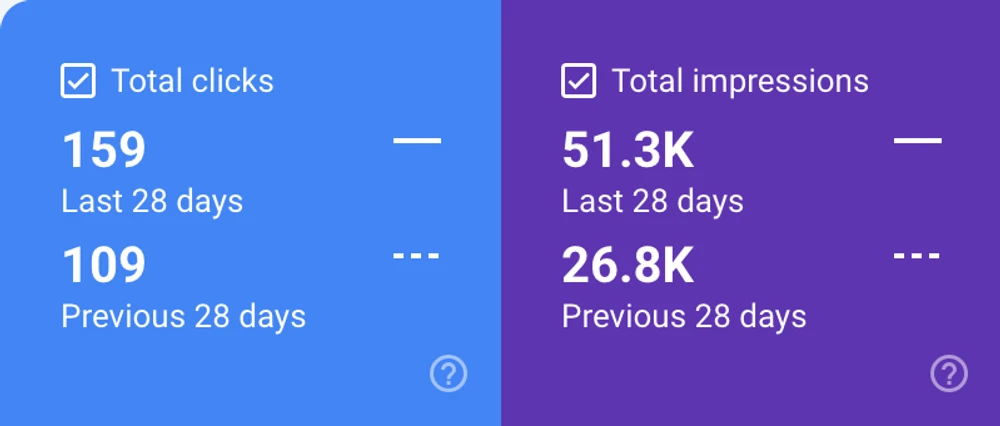
Impressions went from 26,800 to 51,300, a rise of 91%. Clicks went from 109 to 159, up 46%. Average position moved from 28.3 to 17.8, which is 10.5 places across the whole site rather than across a shortlist of terms I picked.
Click through rate reads lower, 0.31% against 0.41%, and that is worth explaining rather than hiding. Impressions nearly doubled while clicks rose by less, because the pages coming back are re-entering at position 15 to 20 rather than at the top. They are being seen again before they are being chosen. Getting seen has to come first.
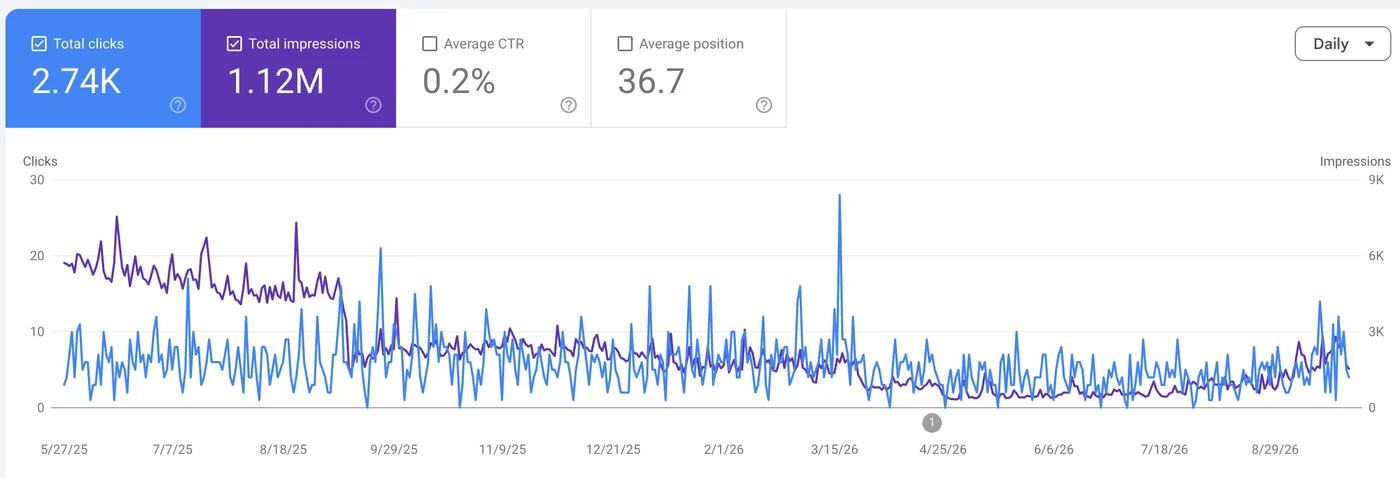
The longer view is the one I would point at. The line on the right is back to roughly where it sat before the pages were deleted. Five months of decline, recovered in about four weeks.
What a month of this actually looked like
Twenty three of the thirty one days carry logged, shipped work, from the first day in the backend on 26 August to the last guide published on 25 September.
Not planning documents. Pages back up, redirects remapped, titles deduplicated, schema written, images converted and renamed by hand, six guides researched and written, fifteen pages reworked underneath them, a link profile audited domain by domain to 272 entries. Six of those guides went out in eight days at the end, while the recovery work was still running alongside them.
I am putting that here because the number at the top of this page is a month old and people will assume a month is a small amount of work. It was not a small amount of work. It was roughly a quarter’s worth, run into four weeks, because a site losing money every week it stays broken does not have a quarter to give.
Why I am publishing this at one month
Because a month is the interesting part, and nobody shows it.
Case studies get written at the end, when everything has settled and the result is safe to claim. That is useful for deciding whether to hire someone and useless for knowing what the first month of the work actually looks like.
It is not finished. The suburb pages that are back are climbing rather than arrived, there are more of them still to rebuild, and the disavow file is still waiting to go up. What is already true is that the fall took five months and undoing most of it took one.
This engagement ran on SEO and Content Marketing. Results are measured the way the guarantee defines them: calls, leads, and booked work. Your own market decides your own numbers.
Want numbers like these in your own market?
Book a free consultation. I will show you what is standing between your business and the calls, the same way I did for this removals client.